


Key Takeaways
- Root Cause vs. Discipline: Persistent time management struggles often stem from executive dysfunction, ADHD, dyscalculia, or processing speed deficits, not poor discipline or laziness.
- The Planner Paradox: Standard organizational tools like day planners frequently fail because they demand the exact working memory and temporal forecasting abilities that neurodivergent students lack.
- Beyond ADHD: Learning differences like dyscalculia disrupt time perception by impairing numerical estimation, sequential reasoning, and the ability to calculate elapsed time.
- Diagnostic Clarity: A comprehensive psychoeducational assessment identifies the exact cognitive profile and unlocks formal classroom accommodations (such as Nova Scotia Adaptations Assistive Technology, and/or resource support).
If your household feels like a daily battle against the clock, you are not alone.
As a registered psychologist working with families across Nova Scotia for nearly two decades, I frequently meet exhausted parents who tell me the exact same story: “We have bought every planner on the market, set phone alarms every ten minutes, and created visual rewards charts. Why can’t my child just stick to a schedule?”
When standard organizational strategies consistently fail, it is rarely a matter of effort or willpower. In my clinical practice, we find this is almost always a sign that a cognitive processing difference is being treated as if it were a simple lack of discipline.
Is It Executive Dysfunction? Why Standard Planners Fail Neurodivergent Students
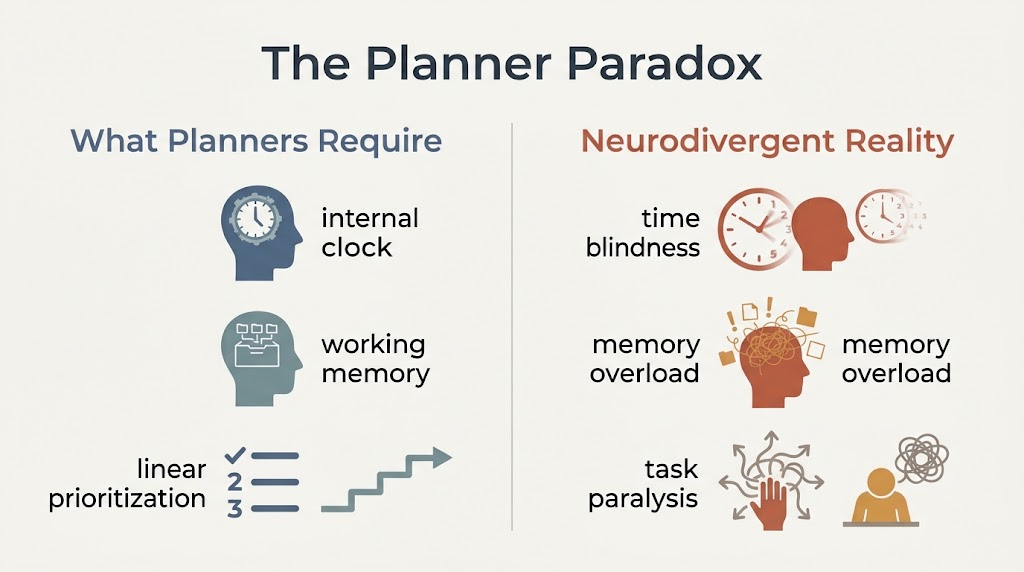
Many parents and educators assume that teaching time management is simply a matter of introducing the right organizational tool. However, in my clinical practice, I often remind families of a fundamental truth: planners do not build executive functioning; they require it.
Executive functions are the brain’s command center. They manage working memory, impulse control, emotional regulation, and temporal forecasting—the mental ability to project oneself into the future and gauge how long a task will take.
When a student struggles with executive dysfunction, handing them a day planner is like giving glasses to someone who needs a hearing aid. The tool assumes cognitive capacities that are impaired.
Instead of organizing their day, the planner becomes a visual reminder of failure, inducing anxiety and task avoidance.
Beyond ADHD: 3 Learning Differences That Disrupt Time Perception
While Attention-Deficit/Hyperactivity Disorder (ADHD) is the most widely recognized cause of time management difficulties, it is far from the only one. Diagnostic testing at our Stellarton clinic frequently reveals underlying neurodevelopmental differences that alter how a student perceives and processes time.
1. Attention-Deficit/Hyperactivity Disorder (ADHD) & Time Blindness
Students with ADHD often experience what researchers call time blindness. Because dopamine signaling in the brain’s prefrontal cortex operates differently, time is rarely perceived as a continuous, linear flow.
Instead, time is filtered into two distinct states: Now and Not Now.
If a term paper is due in two weeks, the student’s brain categorizes it as “Not Now,” making task initiation nearly impossible until the deadline turns into an immediate, high-stress “Now.”
If this pattern sounds familiar, our ADHD evaluation can help determine whether time blindness is part of a broader attention profile.
2. Dyscalculia and the Numerical Time Gap
While dyscalculia is traditionally understood as a math learning disability, its impact extends deep into temporal processing. Time management relies heavily on numerical estimation and spatial reasoning.
A student with dyscalculia may struggle to:
- Calculate elapsed time (e.g., estimating how many minutes remain between 3:15 PM and 4:00 PM).
- Read and mentally translate analog clock faces into abstract schedules.
- Count backward from a future deadline to establish a start time.
When numerical processing is impaired, time remains an abstract, unpredictable concept rather than a reliable structure — a pattern that holds up even in non-visual, auditory time-estimation tasks, suggesting the struggle isn’t just about reading a clock face. A specialized dyscalculia assessment can clarify whether numerical processing is behind your child’s time management struggles.
3. Processing Speed Deficits & Execution Lag
Processing speed refers to the rate at which a student’s brain takes in information, translates it, and formulates a response. A student with a processing speed deficit may have exceptional intellectual abilities, but their execution takes significantly longer than peers.
When an educator assigns a task estimated for 20 minutes, a student with slow processing speed may require 50 minutes to complete the exact same mental steps.
This creates a severe execution lag, leading parents and teachers to mistakenly assume the student spent 30 minutes wasting time or procrastinating. Processing speed is one of the core cognitive domains measured during a psychoeducational assessment, helping to distinguish it from attention or motivation issues.
Behavioral Habit vs. Learning Difference: The Clinical Triage Framework
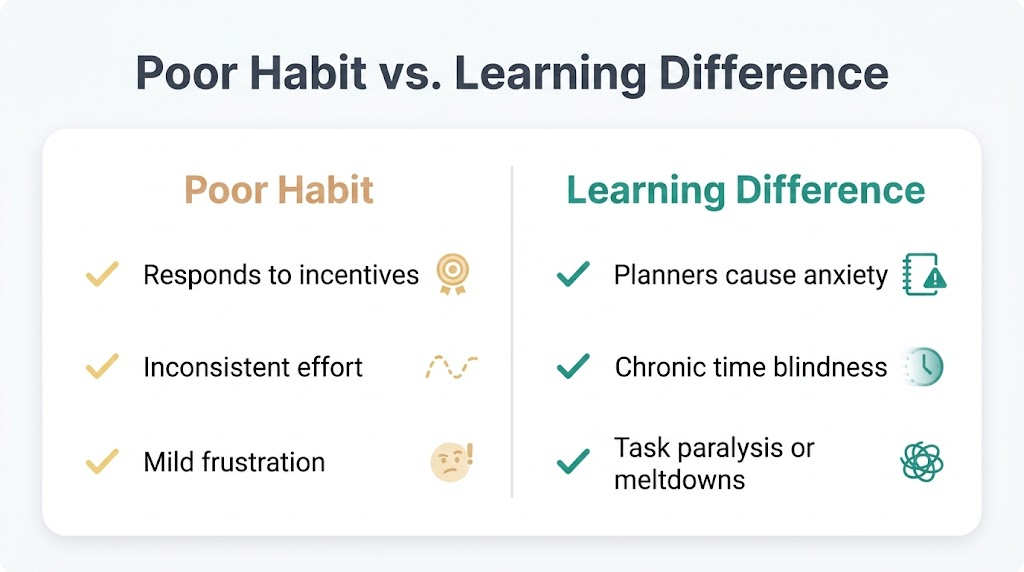
Differentiating between a typical organizational habit gap and a neurodevelopmental difference is critical for providing the right support. Below is the clinical observation framework we use to guide families during initial consultations:
| Diagnostic Indicator | Behavioral Habit / Poor Skill | Learning Difference / Executive Dysfunction |
| Response to Tools | Improves quickly when calendars, phone alarms, or rewards are introduced. | Standard planners increase anxiety; tools are routinely abandoned despite genuine effort. |
| Consistency | Performance fluctuates based on fatigue, interest, or motivation. | Chronic breakdown occurs across both high-interest and low-interest tasks. |
| Time Estimation | Can accurately estimate how long a task takes when focused. | Experiences severe “time blindness”; cannot distinguish 15 minutes from 2 hours. |
| Cognitive Domain | Primarily an organizational or routine gap. | Impaired working memory, numerical processing, or processing speed deficits. |
| Emotional Impact | Occasional frustration, mild avoidance, or typical procrastination guilt. | Severe shame, paralysis, task avoidance, or tearful emotional meltdowns. |
When a child’s time management difficulties are accompanied by intense emotional distress or severe task paralysis, pushing harder with standard discipline often backfires. It reinforces feelings of inadequacy and damages the parent-child relationship.
Need Clarity on Your Child’s Unique Profile? If these patterns look familiar, a comprehensive assessment can provide the answers you need. Learn how our psychoeducational assessments work or speak directly with our intake team.
How a Psychoeducational Assessment Pinpoints the Root Cause
When time management struggles threaten a student’s academic confidence and emotional well-being, getting an accurate diagnosis is the most empowering step forward.
A psychoeducational assessment goes beyond surface-level symptoms to map out your child’s exact cognitive profile. Here is our 4-step clinical pathway:
- Comprehensive Intake & Context Gathering: We begin by listening to your family’s story, reviewing developmental history, school report cards, and previous educational interventions.
- Standardized Psychometric Testing: Through direct, engaging clinical sessions, we measure core cognitive domains—including IQ, processing speed, working memory, academic fluency, and spatial reasoning.
- Diagnostic Synthesis: We analyze the data to identify or rule out specific learning differences (such as Dyscalculia, Dyslexia, or Processing Deficits) and Executive Functioning Impairments (like ADHD).
- Tailored Action & Accommodation Plan: You receive a detailed report outlining your child’s strengths and exact recommendations for home routines, therapeutic support, and formal school accommodations If you are exploring support options for your child’s school, request an initial assessment consultation with our multidisciplinary team.
Frequently Asked Questions About Time Management & Learning Differences
Can a child have high intelligence and still struggle with time management?
Yes, absolutely. Intellectual capacity (IQ) and executive functioning are distinct cognitive domains. Highly intelligent or gifted students frequently experience severe executive dysfunction or processing speed deficits. Often, their intellect allows them to mask these struggles in early grades until academic demands increase and overwhelm their coping mechanisms.
Is time blindness considered a symptom of dyscalculia?
Yes. Because time measurement relies on numerical reasoning, sequential thinking, and spatial estimation, individuals with dyscalculia frequently experience difficulties managing time. They may struggle to read analog clocks, calculate time intervals, or accurately forecast how long a routine activity will take.
How does a formal assessment help my child at school?
A psychoeducational assessment provides formal clinical documentation recognized by Nova Scotia school boards and academic institutions. This evaluation identifies specific learning needs and unlocks formal classroom accommodations—such as extended time on exams, modified assignment deadlines, assistive technology, and tailored IPP (Individual Program Plan) goals.
Ready to find out whether your child’s could include these supports? Book an assessment consultation with our Stellarton team.
Take the Next Step Toward Diagnostic Clarity
You do not have to navigate these challenges alone. At North Shore Psychological Services, our team of experienced psychologists, is committed to providing compassionate, evidence-based answers for your family.
Located in Stellarton, Nova Scotia, we offer supportive therapy alongside specialized diagnostic evaluations tailored to your child’s unique journey.
Ready to find out what is really going on? Schedule a Consultation with Our Stellarton Clinic Team Today.
About the Author
Lisa Hayden, M.A., Registered Psychologist, is the Founder and Clinic Director of North Shore Psychological Services in Stellarton, Nova Scotia. With over 19 years of clinical experience, Lisa specializes in neuro-affirming psychoeducational assessments, ADHD evaluations, and family support, helping children, teens, and parents translate cognitive insights into practical, life-changing strategies. Read Lisa’s full clinical profile and practice history on our About Our Practice Page.
Clinical & Medical Disclaimer
The information provided in this article is for educational and informational purposes only and is not intended as medical, psychological, or diagnostic advice. Reading this content does not establish a psychologist-patient relationship. If you suspect your child or family member has a learning difference, executive dysfunction, or ADHD, please consult a licensed healthcare professional or registered psychologist for a formal psychoeducational evaluation tailored to your specific situation.
Crisis & Emergency Support Resources
If you or someone you know is experiencing a mental health crisis, immediate assistance is available:
- In Nova Scotia: Call the Mental Health & Addictions Crisis Line at 1-888-429-8167 (24/7).
- Canada & USA: Call or text 988 to reach the Suicide & Crisis Lifeline.
- Text Support: Text HOME to 741741 to connect with the Crisis Text Line.
- Immediate Danger: Call 911 or go to your nearest hospital emergency department.