

As a parent, there is nothing quite like the feeling of watching your child struggle. You see them study for days, review flashcards at the kitchen table, and explain the material to you perfectly.
Yet, the next afternoon, they come home from school in Nova Scotia or Stellartion, Truro or Antigonish with a blank test paper and tears in their eyes. In over 20 years as a registered psychologist, I have sat on the couch with hundreds of families across Pictou County who are facing this exact cycle. They often tell me they feel helpless.
The bright, capable child they know at home seems to vanish the moment a test sheet lands on their desk. If this sounds familiar, I want you to take a deep breath. Your child is not lazy, and you are not failing them.
We simply need to understand how their brain is reacting to pressure, and find the right clinical tools to help them feel safe, confident, and understood.
Key Takeaways:
- Nerves vs. Anxiety: Typical nerves are manageable, but severe test anxiety physically triggers a fight-or-flight response that freezes logical thought.
- The Masking Effect: Severe exam panic frequently masks an undiagnosed learning challenge (such as dyslexia or dyscalculia) or executive functioning needs (ADHD), which commonly co-occurs with anxiety.
- Provincial Support: A formal psychoeducational assessment official classroom accommodations and IPPs in Nova Scotia schools.
- Immediate Grounding: Calming the physical body via somatic feedback and sensory grounding must happen before the thinking brain can go back online.
[Table Of Contents]
Is It Just Pre-Exam Jitters or Severe Test Anxiety?
It is completely normal for students to feel a little bit of excitement or nervousness before a big test. In fact, a small amount of adrenaline can actually help them focus and perform well.
However, when those feelings overflow and turn into a wall of panic, we are no longer dealing with simple nerves.
True test anxiety is a form of performance anxiety that physically hijacks your child’s nervous system. When the brain perceives a test as an existential threat, it triggers a “fight-or-flight” response.
This hormonal surge floods their system, making logical thinking and memory recall chemically impossible in that moment.
To help you identify what is happening, we need to look closely at how these symptoms present in daily life. Severe anxiety rarely stays quiet; it speaks through your child’s body, emotions, and behaviors.
Red Flags: What Does Severe Test Anxiety Actually Look Like?
In my practice at North Shore Psychological Services, I often hear parents describe symptoms that go far beyond a simple “I’m worried about this test.”
Here are the most common signs that your child’s pre-exam stress has crossed the line into clinical test anxiety:
- Physical Symptoms: Stomachaches, tension headaches, or nausea on the morning of an exam. You might also notice them sweating, shaking, or complaining of a racing heart.
- Cognitive Freezing: Extreme “mind-blank” experiences where a student who knew the material perfectly the night before suddenly cannot recall basic facts during the exam.
- Behavioral Avoidance: Refusal to attend school on test days, refusing to study because it feels too overwhelming, or throwing tantrums when homework is brought out.
- Emotional Meltdowns: Outbursts of anger, prolonged crying spells, or feelings of intense worthlessness leading up to assessment weeks.
If several of these signs sound familiar, you don’t need to figure it out alone — reach out to our Stellarton clinical team for an initial conversation about what your child might be experiencing.
I recall working with a bright teenager from Pictou County
who studied tirelessly for every single math exam. Yet, the second walked into the classroom, r hands would shake so violently could barely hold her pencil.
wasn’t struggling with the math; was struggling with a nervous system that felt completely unsafe.
The Nerves vs. Needs Framework: Could an Underlying Learning Challenge Be Masking as Anxiety?
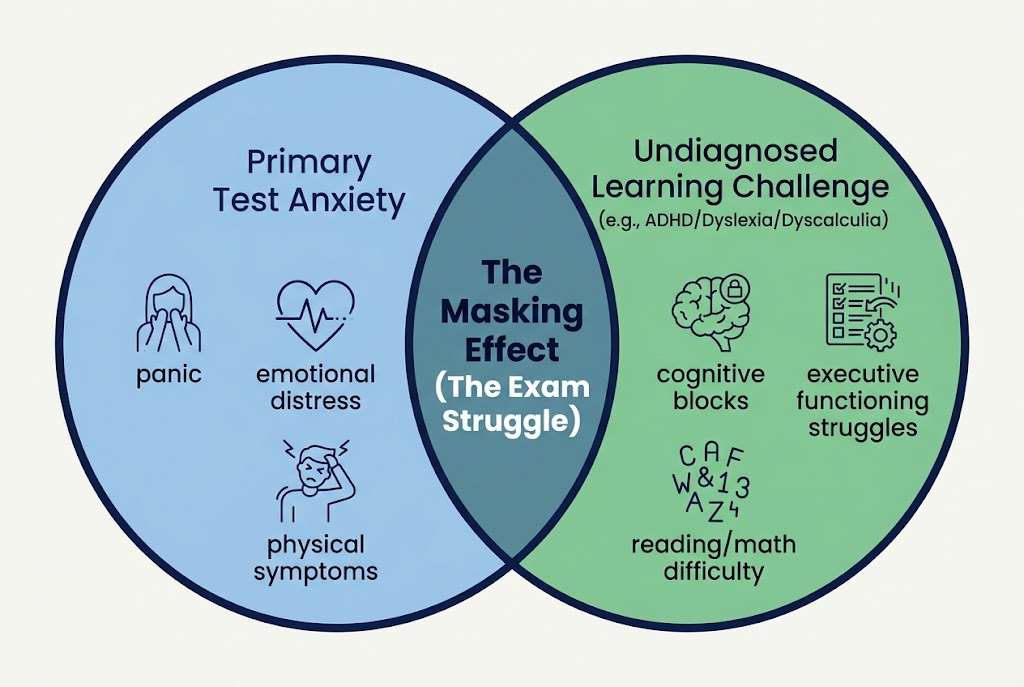
When coping strategies like deep breathing or positive self-talk fail to make a dent in your child’s anxiety, we have to ask a deeper question. When coping strategies like deep breathing fail to make a dent, we must ask if the anxiety is actually a symptom of an undiagnosed learning difference.
In my school psychology career, I have repeatedly observed what I call the Masking Effect. When a student has an undiagnosed learning disability—like dyslexia, dysgraphia, or dyscalculia—or executive functioning struggles like ADHD, school is an everyday uphill battle.
They have to work twice as hard as their peers just to keep up, which creates chronic, low-level cognitive fatigue.
When test day arrives, the pressure cooker overflows. The student knows they struggle to process text or organize numbers quickly, so the timed environment feels like a trap.
The resulting panic attack isn’t just “nerves”; it is a logical response to an academic environment that does not match how their brain naturally learns.
A Deeper Look: When test anxiety is paired with undiagnosed ADHD, dyslexia, or dyscalculia, traditional anxiety coping strategies are rarely enough. The timed exam environment triggers a panic response because the student’s brain cannot process information using standard academic methods. A psychoeducational assessment is required to identify these underlying processing differences.
The Masking Effect: How ADHD, Dyslexia, and Dyscalculia Hide Behind Exam Panic
To help you understand if your child’s anxiety is tied to a deeper learning need, I have mapped out the key differences between primary test anxiety and anxiety driven by an underlying processing challenge.
| Feature / Behavior | Primary Test Anxiety (Nerves) | Learning Difference-Driven Anxiety (Needs) |
| Study Preparation | Student understands the homework but panics only during the actual evaluation. | Student struggles deeply with homework and reading comprehension, even without a test. |
| Anxiety Trigger | Tied specifically to grades, performance evaluation, or fear of failure. | Tied to the high cognitive load of reading, writing, or calculating under a time limit. |
| Response to Tutoring | High comprehension during calm, one-on-one sessions; poor performance on tests. | Continued struggle to grasp foundational concepts despite repeated, specialized instruction. |
| Primary Brain Deficit | Emotional regulation and stress response pathways are temporarily overloaded. | Underlying neurological processing differences in working memory, language, or math. |
If you recognize your child in the “Needs” column of this framework, please know that breathing exercises alone will not resolve their struggles. We need to look deeper to find the actual answers.
Our team at North Shore Psychological Services specializes in uncovering these exact patterns.
If you suspect your child’s anxiety is masking a deeper academic struggle, I invite you to explore our specialized Psychoeducational Assessment Services to learn how we map out their unique learning profile.
Navigating the Nova Scotia School System: Moving from Panic to Classroom Accommodations
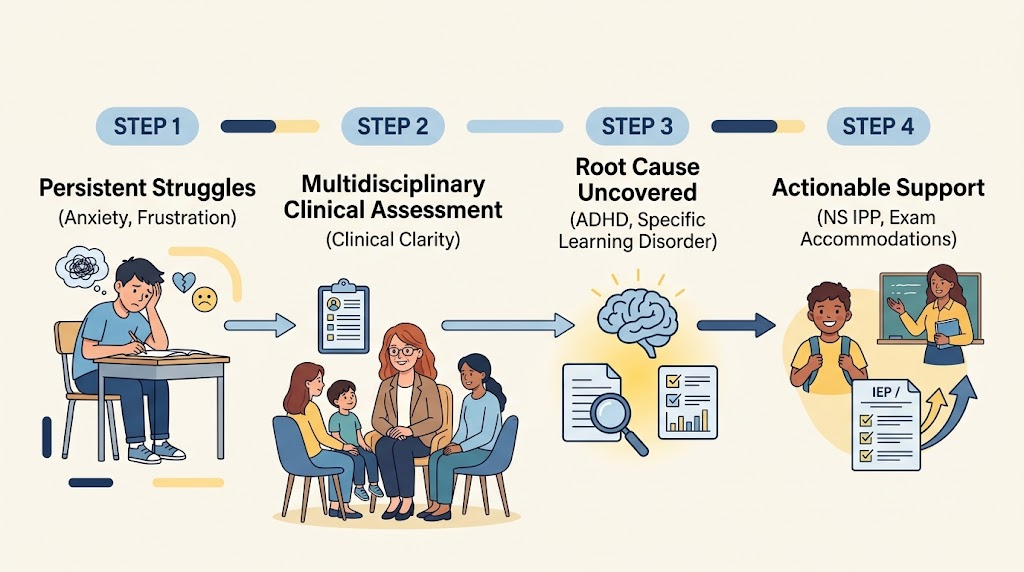
As a parent in Nova Scotia, you have a powerful tool at your disposal to protect your child’s academic well-being. The provincial education system has specific legal and educational frameworks designed to support students who learn differently.
However, accessing these supports requires the right documentation.
During my 10 years working directly the Chignecto Central Regional School Board (CCRSB), I learned exactly what administrators and resource teachers need to classroom supports.
They cannot make formal changes based on a parent’s suspicion or a general doctor’s note. To access formal testing accommodations like extra time or a quiet space in Nova Scotia schools, you need a comprehensive psychological evaluation.
This evaluation is what we call a Psychoeducational Assessment. It is a standardized clinical process that measures your child’s cognitive abilities, academic skill levels, and information-processing systems to identify exactly where the bottleneck is occurring.
The Local Standard: To access formal testing accommodations like extra time or a quiet space in Nova Scotia schools, students must have a psychoeducational assessment. This clinical report provides the diagnostic evidence required by regional school boards to implement an Individual Program Plan (IPP) or officially document specific classroom adaptions.
How a Psychoeducational Assessment Unlocks IPPs and Exam Support
When we complete an assessment at our Stellarton clinic, we don’t just hand you a diagnosis and send you on your way. We provide a highly customized roadmap that translates our clinical findings into actionable school recommendations.
Under the Nova Scotia Department of Education guidelines, a formal diagnosis of a Learning Disability, ADHD, or Generalized Anxiety Disorder can unlock essential accommodations, which may include:
- Adaptations: Practical classroom changes that do not alter the curriculum. This includes receiving extra time (usually double time) on tests, writing exams in a separate, quiet space to reduce sensory distractions, or using assistive technologies like Read&Write software.
- Individual Program Plans (IPPs): Curricular adjustments if your child’s learning needs require changes to the actual grade-level curriculum outcomes. This plan is designed collaboratively with you, the classroom teacher, and the resource team to ensure your child can learn at a pace that fits their brain.
- Provincial Assessment Supports: Mandated accommodations during the provincial Nova Scotia Assessments in Grades 3, 6, and 8, ensuring your child has a documented history of assessment support.
Having these accommodations in place completely changes the emotional landscape for a child.
Suddenly, the timed exam is no longer a threat because they know they have the time, space, and tools they need to succeed.
Immediate, Practical Strategies to Help Your Child Cope at Home
While we work together to find long-term answers through assessments or therapy, there are evidence-based tools you can use at home starting tonight. We must calm the body’s physical fight-or-flight response before we can hope to calm the mind.
When your child is spiraling into test panic, their prefrontal cortex (the thinking brain) is offline. Telling them to “just relax” or “think positive” is physically impossible for them to process.
Instead, we must use physical, sensory-based strategies to send safety signals back up to their brain.
Here is a simple, three-step grounding ritual you can teach your child to use at their desk when they feel the panic starting to rise:
- Tactile Somatic Feedback (The Desk Press): Have your child place their hands flat under their school chair or desk, push upward as hard as they can for five seconds while pressing their feet firmly into the floor, and then release. This muscle contraction burns off excess adrenaline and grounds them in their physical space.
- Sensory Grounding (The 3-2-1 Method): Teach them to silently look around the classroom to identify three things they can see, two things they can physically feel (like their sleeves or the wooden desk), and one sound they can hear. This shifts their focus away from internal panic thoughts and back to the physical present.
- Deep Diaphragmatic Release (The “Cool Down” Sigh): Instruct them to take a deep breath in through their nose, follow it with a second short sniff to completely fill their lungs, and let out a slow, heavy sigh through their mouth. This specific breathing pattern immediately triggers the vagus nerve to slow down their heart rate.
By practicing these steps at the kitchen table during homework time, your child will build a sensory “rescue toolkit” they can rely on during actual exams. Pairing this toolkit with strong daily habits — like the routines in our student time management and study strategies guide — reduces the chronic academic pressure that fuels test-day panic in the first place.
Frequently Asked Questions About Test Anxiety and School Support in NS
Can a student get extra time on Nova Scotia provincial assessments for anxiety?
Yes. If a student has a documented history of severe anxiety or an underlying learning challenge supported by a psychoeducational assessment, they are eligible for provincial adaptations. This includes extra time, a quiet writing environment, or having instructions read aloud.
What is the difference between a school-based adaptation and an IPP?
An adaptation changes how your child learns and demonstrates their knowledge (e.g., extra time, speech-to-text software) without changing the grade-level curriculum. An IPP (Individual Program Plan) actually alters what they are expected to learn because their academic needs require a modified curriculum.
How long does a psychoeducational assessment take at your Stellarton clinic?
The assessment process is comprehensive and typically takes place over several sessions. It includes an intake interview with parents, direct testing sessions with your child (spread out to prevent fatigue), and a final feedback meeting where we explain the results and hand you our detailed report. We aim to provide a one page feedback form the day of assessment provided all collateral documentation is received. with a comprehensive feedback and written report 2 weeks later.
Your Next Step Toward Answers and Academic Relief
You do not have to navigate this stressful journey alone. Whether your child is dealing with severe test anxiety that requires compassionate, evidence-based counseling, or they need a comprehensive psychoeducational assessment to unlock critical school support, we are here to guide you.
At North Shore Psychological Services, we are committed to helping families across Nova Scotia move beyond school struggles and build lasting resilience. We provide a safe, respectful, and completely non-judgmental environment where your child can be themselves.
Let’s work together to find the clear answers and practical tools your family deserves.
Please take a moment to visit our Secure Intake Form today to schedule an initial consultation with our experienced clinical team at our Stellarton office.
About the Author
Lisa Hayden, MA, is a Registered Psychologist licensed by the Nova Scotia Regulator of Psychology (NSRP) (formerly NSBEP) and the founder of North Shore Psychological Services in Stellarton, Nova Scotia.
With over 19 years of school-based and clinical experience, she specializes in evidence-based childhood therapy and diagnostic psychoeducational assessments.
Lisa is deeply committed to a compassionate, neuro-affirming approach that empowers families to understand how their child’s unique brain works so they can confidently thrive. Learn more about her background and qualifications on the Lisa Hayden Professional Bio Page.
Clinical & YMYL Disclaimer: The information provided in this article is designed for educational and informational purposes only. It is not intended to be a substitute for professional mental health advice, clinical diagnosis, or medical treatment. Always consult with a registered psychologist, medical practitioner, or other certified healthcare professional regarding any clinical concerns or educational support plans.
Emergency & Crisis Resources: If you, your teen, or a loved one is experiencing severe emotional distress, immediate help is available.
- National Canada Hotline: Call or text 988 to reach the Suicide Crisis Helpline (24/7, free, and completely confidential).
- Nova Scotia Provincial Crisis Line: Call 1-888-429-8167 for the Mental Health Crisis Line.
- Crisis Text Line: Text CONNECT to 686868 to connect with a Kids Help Phone crisis responder.
- Immediate Danger: Call 911 or visit your nearest emergency room.