

In my clinical practice in Stellarton and Truro, parents often arrive with the same painful story about a bright, verbal child who hits a wall at school.
They tell me: “She can debate science or history at the dinner table with total clarity. But ask her to write three sentences in a notebook, and she completely shuts down. It turns into two hours of tears. Is she digging her heels in, or is something else going on?”
If your evenings look like this, keep this fact in mind: Your child is not being lazy, stubborn, or careless.
Over the past ten years, our team has completed psychoeducational assessments for hundreds of students across Nova Scotia. When an intelligent child struggles day after day with reading, spelling, or getting words onto paper, there is almost always a measurable processing difference beneath the surface. Most of the time, the issue comes down to Dyslexia, Dysgraphia, or a mix of both.
The Bottom Line: Dyslexia vs. Dysgraphia at a Glance
Dyslexia is a language-based learning disability that disrupts reading decoding and phonological processing. Dysgraphia is a neurological condition that impairs handwriting mechanics, orthographic retrieval, and written expression. While Dyslexia affects how the brain takes in print, Dysgraphia affects how the brain transfers thoughts onto paper. A comprehensive psychoeducational assessment separates these conditions through standardized cognitive, motor, and academic achievement tests.
Key Clinical Takeaways
- Input vs. Output: Dyslexia impairs how sounds connect to letters during reading (an input issue). Dysgraphia impairs fine-motor planning and memory for letter forms during writing (an output issue).
- Distinct Spelling Errors: Students with Dyslexia usually spell phonetically (they spell what they hear). Students with Dysgraphia make inconsistent, non-phonetic mistakes like skipping syllables, mixing uppercase and lowercase letters, or omitting letters entirely.
- The Assessment Profile: An evaluation identifies these conditions by contrasting strong verbal reasoning against specific drops in phonological awareness (CTOPP-2) versus visual-motor integration (Beery VMI) and processing speed (WISC-V).
- Frequent Co-Occurrence: In a large Mayo Clinic population study, about three out of four children with a written-language disorder also had a reading disability, meaning many students need separate interventions for reading and writing.
- Classroom Accommodations: Dyslexia responds to structured literacy programs like Orton-Gillingham. Dysgraphia requires output workarounds, such as speech-to-text software, typing accommodations, and grading for knowledge rather than penmanship.
What Is the Fundamental Difference Between Dysgraphia and Dyslexia?
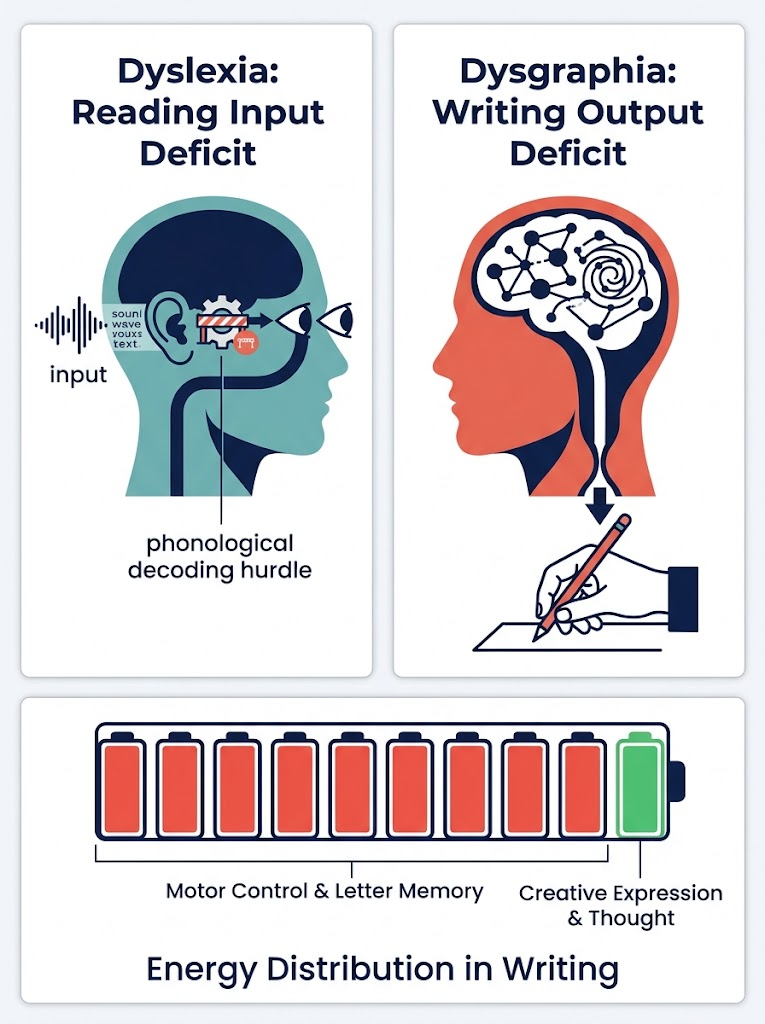
Dyslexia disrupts how the brain decodes printed words (input), while Dysgraphia disrupts how the brain organizes and writes language onto the page (output).
To understand the difference, consider the direction language travels in the brain.
When speaking with parents at North Shore Psychological Services, I describe this as an input versus output problem. Dyslexia blocks the path into the brain when a child tries to read. Dysgraphia blocks the path out of the brain when a child tries to physically produce written work.
Dyslexia: A Language-Based Reading Deficit
Dyslexia stems from a vulnerability in the brain’s phonological processing system.
Children with this profile have trouble mapping spoken sounds (phonemes) to letters and letter groups on the page (graphemes). Because breaking words down into sounds requires heavy conscious effort, reading aloud sounds hesitant, flat, and robotic.
In the classroom, Dyslexia usually looks like this:
- Working hard to sound out unfamiliar words, even after repeated exposures.
- Reading aloud in a slow, staccato pace without natural pauses.
- Guessing at words based on their first letter or general shape.
- Making phonetic spelling mistakes that capture the sounds of a word but ignore correct spelling patterns (like frend instead of friend).
- Maintaining strong listening comprehension while struggling to read the same material independently.
When a child with Dyslexia writes, their spelling problems stem directly from their reading difficulties. Because their internal blueprint for how words look and sound is unstable, spelling remains slow and error-prone.
Dysgraphia: A Visual-Motor and Orthographic Output Deficit
Dysgraphia is a neurological condition that impairs transcription: the physical and mental work of putting text on paper.
It is not an intellectual problem, not due to a child’s intelligence, and it has nothing to do with carelessness. A child with Dysgraphia often reads above grade level, talks with a rich vocabulary, and explains complicated ideas out loud.
The breakdown happens when they pick up a pencil. At that point, two separate systems struggle to work together:
- Orthographic Coding: The brain cannot quickly pull the visual memory of letters and letter sequences out of working memory.
- Motor Planning: The muscles in the fingers and wrist fail to automate the physical strokes needed to write those letters smoothly.
In the classroom, Dysgraphia usually looks like this:
- Gripping the pencil tightly with white knuckles, leading to hand cramps within five to ten minutes.
- Writing with inconsistent letter sizing, erratic word spacing, and random uppercase letters in the middle of words.
- Explaining an essay topic thoroughly in conversation, but producing only one or two flat sentences on paper.
- Falling behind when copying notes from the board, even when reading the board is easy.
- Resisting written assignments, which teachers and parents often mistake for avoidance or bad attitude.
If you are trying to determine whether your child’s difficulties stem from reading or handwriting, review our psychoeducational assessment services to see how we evaluate both areas.
The Cognitive Energy Allocation Model: Why Writing Drains Your Child
Parents often wonder how their child can finish an oral math quiz in five minutes, but take over an hour to write down four answers on a worksheet.
To help families understand this drain on working memory, I use the Cognitive Energy Allocation Model.
Picture a child’s working memory as a battery with 10 units of mental energy:
- For a typical writer: Motor execution is automatic. The brain runs the pencil using 1 unit of energy, reserving 9 units for word choice, sentence structure, and critical thinking.
- For a child with Dysgraphia: Automation never sets in. The brain burns through 9 units just remembering which way a “b” faces, holding the pencil steady, and staying between the blue lines.
That leaves only 1 unit for actual thinking, complex executive functioning including planning and organization. When these students push their paper away and refuse to write another word, they are not throwing a tantrum. Their working memory has simply run out of charge.
Dysgraphia vs. Dyslexia: Side-by-Side Comparison Matrix
Both conditions can cause poor spelling and frustration at school, but their neurological causes call for different clinical interventions.
The table below contrasts how Dysgraphia and Dyslexia appear across everyday academic tasks:
| Diagnostic Area | Dyslexia (Reading Profile) | Dysgraphia (Writing Profile) |
| Core Difficulty | Phonological awareness, decoding words, and reading fluency. | Letter formation, orthographic recall, and written expression. |
| Neurological Basis | Auditory-language processing differences in the left hemisphere. | Disruptions in motor planning, visual-motor integration, and orthographic memory. |
| Reading Aloud | Slow, choppy, and effortful; frequently omits or misreads words. | Fluent and expressive; reads at or above age expectations. |
| Spelling Errors | Phonetically sensible errors (e.g., elefant for elephant). | Chaotic, non-phonetic errors (e.g., missing syllables, mixed cases like eLpht). |
| Pencil Grip & Stamina | Standard pencil grip; typical writing endurance without physical pain. | Awkward, tight grip; quick onset of hand fatigue, cramps, and posture changes. |
| Verbal vs. Written Output | Spoken language generally aligns with reading comprehension. | Sharp split: Articulate speaking contrasted with brief, basic written work. |
| Math Work | Struggles with text-heavy word problems; computation runs smoothly. | Struggles to keep numbers aligned in columns or draw geometric shapes. |
| Primary Classroom Help | Structured literacy instruction (such as Orton-Gillingham). | Assistive tools (voice typing, scribes) and grading focused on content, not penmanship. |
Can a Child Have Both Conditions?
Yes. In a large Mayo Clinic population study, roughly three out of four children with a written-language disorder also had a reading disability.
When these conditions overlap, school becomes exhausting. The student struggles to read the assignment directions, and then faces an equal physical battle trying to write down their thoughts.
To design an effective school plan, an evaluation must pinpoint which form of dysgraphia is present.
Dyslexic Dysgraphia vs. Motor Dysgraphia
During testing, we look for distinct patterns to identify the specific subtype:
- Dyslexic Dysgraphia: Spontaneous writing is hard to read and spelling is weak, yet copied text from a book remains legible. Finger tapping speed and basic motor coordination are normal.
- Motor Dysgraphia: Both spontaneous writing and copied text are illegible because of poor fine-motor coordination, low finger strength, or poor muscle tone.
- Spatial Dysgraphia: Writing runs off the page, slants unevenly, and ignores line margins because of visual-spatial processing difficulties, even when motor control is intact.
If these patterns sound familiar in your child’s daily work, you can fill out our clinical intake form to start identifying what is behind their struggle.
Phonetic vs. Orthographic Errors: Reading Your Child’s Spelling
A child’s spelling errors provide clear clues about how their brain processes written language:
The Dyslexic Pattern (Auditory Over-Reliance): Children with Dyslexia lean entirely on what they hear because they struggle to store the visual look of words. They write sed for said, wuz for was, or serkul for circle. Every phoneme is accounted for, but the spelling conventions are missing.
- The Dysgraphic Pattern (Visual-Motor Breakdown): Children with Dysgraphia make errors that ignore phonetic rules. They drop middle vowels, leave out entire syllables, or scramble letter orders (btu for but). Capital letters often appear mid-word (sCHool) simply because the student’s hand opted for the easiest physical motion.
How a Psychoeducational Assessment Tells Them Apart
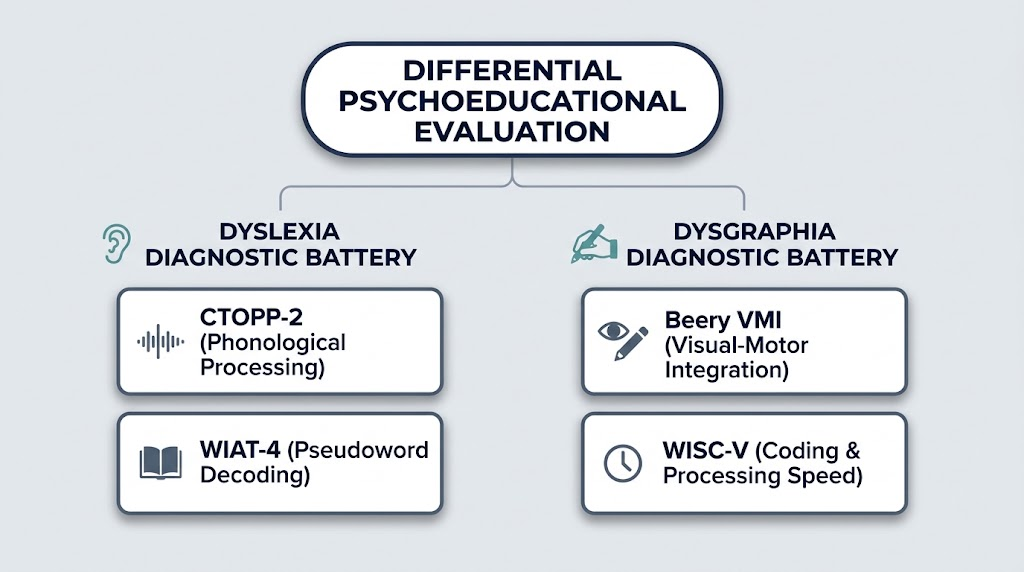
Separating Dyslexia from Dysgraphia requires standardized testing that compares verbal intelligence against phonological skills, motor coordination, and visual-spatial memory.
Screening tools and school check-ins often miss the mark because they focus on end-of-term grades rather than cognitive processing. An accurate diagnosis relies on standardized batteries administered by a registered psychologist.
You do not need to memorize these test names. Our job is to administer the tasks, analyze the data, and give you an actionable plan for your child’s teachers.
1. Evaluating Phonological Processing and Reading Decoding (CTOPP-2 & WIAT-4)
To evaluate for Dyslexia, we look at how your child manipulates speech sounds and connects them to letters:
- CTOPP-2: We test phonological awareness with exercises like phoneme elision (asking a student to say “farm” without the /f/ sound). We also evaluate Rapid Automatized Naming (RAN), which measures how quickly a child names common numbers, colors, or objects. A drop in phonological awareness alongside slow naming speed is a classic signature of Dyslexia.
- WIAT-4: We assess real word reading and Pseudoword Decoding (sounding out invented words like splab or flimp). Nonsense words cannot be memorized from sight, so they reveal a student’s actual decoding skills. When a child has strong verbal intelligence but falls behind on nonsense words, Dyslexia is usually the reason.
2. Evaluating Fine-Motor Coordination and Visual-Motor Integration (Beery VMI & WISC-V)
To evaluate for Dysgraphia, our focus shifts from auditory language to visual-motor execution:
- Beery VMI: The child copies a series of geometric shapes that become increasingly detailed. This sub-test shows how well the eyes and the small muscles of the hand communicate. Low scores here point toward motor-based Dysgraphia.
- WISC-V Processing Speed Index (PSI): We use the Coding and Symbol Search sub-tests. In Coding, a child copies symbols into matching numbered boxes under a time limit. Students with Dysgraphia often show a stark cognitive split: their Verbal Comprehension Index might rank in the 90th percentile, while their Processing Speed or Coding scores drop down to the 10th percentile. That statistical gap marks the physical bottleneck of handwriting.
3. Evaluating Orthographic Memory and Written Expression
Finally, we examine how your child turns ideas into written sentences:
- WIAT-4 Sentence Composition & Alphabet Fluency: We measure how quickly and accurately a student writes letters and builds sentences under timed conditions, checking for grammatical structure and writing speed.
- Oral vs. Written Testing: We contrast a student’s oral storytelling against their independent writing. When a child talks with rich, expressive vocabulary, but writes only two or three basic sentences with misspelled words, we have strong clinical evidence of Dysgraphia.
Need Practical Answers for Your Child?
Families in Pictou County, Colchester County, and throughout Nova Scotia regularly tell us that getting a clear assessment report was the turning point in ending daily homework battles.
Complete Our Assessment Intake Form →
Takes about 5 minutes • Completely confidential • No physician referral needed
Classroom Accommodations: Translating the Assessment into Daily Support
A psychoeducational assessment report gives schools the documentation they need to build an Individualized Program Plan (IPP) that modifies reading materials for Dyslexia or bypasses handwriting for Dysgraphia.
In Nova Scotia, our reports outline specific adjustments tailored to regional school boards, including the Chignecto-Central Regional Centre for Education (CCRCE).
Because these two conditions stem from different processing difficulties, the accommodations must target different tasks.
Accommodations for Dyslexia: Adapting Language Input
For Dyslexia, the goal is to bypass the reading bottleneck so the child can learn grade-level material without getting stuck on decoding:
- Using explicit, evidence-based reading instruction, such as Orton-Gillingham programs.
- Setting up text-to-speech tools and access to digital audiobooks through CELA or Bookshare.
- Providing test questions and assignment instructions aloud.
- Giving extra time (typically 1.5x to 2x) on tests that require extensive reading.
- Avoiding unannounced reading aloud in front of classmates.
Accommodations for Dysgraphia: Removing Output Roadblocks
For Dysgraphia, the goal is to separate thinking from handwriting, allowing students to show what they understand without physical exhaustion:
- Setting up speech-to-text dictation tools for paragraphs, book reports, and essay drafts.
- Introducing touch-typing instruction early in elementary school.
- Providing printed class notes or digital slides in advance to cut down on board copying.
- Grading work purely on content, reasoning, and ideas, rather than penmanship or spelling.
- Allowing oral answers or providing an adult scribe for major tests and exams.
What to Expect During Testing
Our testing process is calm, organized, and designed to keep your child comfortable throughout.
If this is your first assessment, the process can feel unfamiliar. Our Stellarton and Truro clinics focus on making the testing room relaxed and encouraging.
Here is how the assessment proceeds:
- Intake Discussion: We meet with parents to review developmental history, family background, and teacher feedback, then tailor our testing battery to your child.
- Standardized Testing Sessions: Your child completes a series of structured cognitive, academic, and fine-motor activities with frequent stretch breaks.
- Data Analysis and Synthesis: We examine the statistical patterns across all sub-tests to pinpoint their cognitive strengths and processing differences.
- Results Consultation: We meet with you to explain the data in plain language, answer your questions, and deliver a practical list of recommendations for your child’s school team.
Frequently Asked Questions
Who can diagnose dysgraphia and dyslexia in Nova Scotia?
In Nova Scotia, formal clinical diagnoses must be completed by a Registered Psychologist licensed by the NSBEP. School screeners, resource teacher checklists, and private tutoring evaluations can point out learning difficulties, but only a licensed psychologist’s evaluation provides the legal backing required for an Individualized Program Plan (IPP) and adaptations
Can a child outgrow dysgraphia or dyslexia?
No. Dysgraphia and Dyslexia are lifelong neurological profiles. That said, with early identification, explicit instruction, assistive technology, and the right school plan, students with these profiles succeed in high school, university, and their careers.
What is the typical turnaround time for an assessment report?
At North Shore Psychological Services, reports are ready within two to four weeks following the testing session, and we review the results with you during a dedicated feedback meeting. We know waiting for answers is stressful, so we keep our timelines direct and predictable.
Does private insurance cover a psychoeducational assessment?
Yes, many extended health plans in Nova Scotia cover some or all of the cost when services are provided by a Registered Psychologist. Benefit plans vary, so call your insurance company beforehand to confirm your annual psychology coverage.
Clarity for Your Child
Seeing your child struggle with schoolwork every afternoon takes an emotional toll on the whole family. It is easy to worry about where this leads, how their self-esteem will hold up, and what their options will look like down the road.
Keep in mind that a diagnosis is not an obstacle. It is practical information.
When students realize their brains simply handle print or motor planning differently, the shame of feeling “behind” or “slow” drops away. Having a clear name for what they are experiencing validates their hard work, eases tension at home, and provides teachers with a practical blueprint to support them.
What to Do Next: A Simple 3-Step Process
If you are ready to get definitive answers about your child’s learning profile, our intake process is direct:
- Submit Your Form: Complete our brief Online Assessment Intake Form describing your child’s academic challenges.
- Intake Review: Our team reviews the details and reaches out within 1 to 2 business days to discuss your needs and set up testing dates.
- Assessment and Results: Complete testing at our Stellarton Office, followed by a feedback meeting and complete school report within 3 to 4 weeks.
Get Answers for Your Child: Complete Our Assessment Intake Form →
About the Author: Lisa Hayden, MA, Registered Psychologist
Lisa Hayden, MA, R. Psych., is the Founder and Clinical Director of North Shore Psychological Services. With over ten years of clinical practice evaluating children and adolescents across Nova Scotia, Lisa specializes in psychoeducational, ADHD, and autism assessments. Her clinical work focuses on identifying individual cognitive profiles so families and educators can replace frustration with effective, targeted support. Learn more about Lisa Hayden and the clinical team →
Clinic Locations: 195 Foord Street, Stellarton, NS | Truro, NS
Phone: +1 (902) 695-3503
Clinical & Medical Disclaimer
This clinical guide is published for educational and informational purposes only. It does not provide medical advice, establish a formal psychological diagnosis, or create a clinician-patient relationship. Formal diagnosis of learning disorders like dyslexia and dysgraphia requires an individualized, in-person assessment by a licensed psychologist or medical specialist. If you suspect your child has learning or developmental difficulties, consult a registered health professional or an assessment clinic in your area.
Crisis & Mental Health Resources
If you, your child, or a loved one are experiencing severe distress or a mental health crisis, immediate confidential help is available 24/7:
- 9-8-8: Suicide Crisis Helpline (Call or text 988 for free support)
- Kids Help Phone: Text CONNECT to 686868 to reach a crisis responder (Kids Help Phone, for young people)
- 911: Call 911 or head to the nearest emergency department for medical or psychiatric emergencies
- (Nova Scotia Residents: The Nova Scotia Mental Health Crisis Line is available 24/7 toll-free at 1-888-429-8167)